
parametric.route_z
route_z( *, port1: photonforge.Port | tuple[photonforge.Reference, str] | tuple[photonforge.Reference, str, int] | collections.abc.Sequence[ photonforge.Port | tuple[photonforge.Reference, str] | tuple[photonforge.Reference, str, int] ] | None = None, port2: photonforge.Port | tuple[photonforge.Reference, str] | tuple[photonforge.Reference, str, int] | collections.abc.Sequence[ photonforge.Port | tuple[photonforge.Reference, str] | tuple[photonforge.Reference, str, int] ] | None = None, radius: Annotated[float, exclusiveMinimum=0, units='μm'] | None = None, alignment: Literal['center', 'port1', 'port2'] | None = None, padding: Annotated[float, minimum=0, units='μm'] | Annotated[ collections.abc.Sequence[Annotated[float, minimum=0, units='μm']], maxItems=2, minItems=2, ] | None = None, pitch: Annotated[float, minimum=0, units='μm'] | None = None, bend: photonforge.Component | collections.abc.Sequence[photonforge.Component] | None = None, straight_kwargs: Annotated[dict[str, Any], _] | None = None, s_bend_kwargs: Annotated[dict[str, Any], _] | None = None, technology: photonforge.Technology | None = None, name: str | None = None, route_model: photonforge.Model | None = None, bundle_model: photonforge.Model | None = None,) -> photonforge.ComponentRoute the connection between parallel ports.
Args
- port1: First port to be connected. The port can be specified as a
Portor as a tuple including aReference, the port name, and the repetition index (optional, only for array references). A sequence of ports can be used for bundle routing. - port2: Second port to be connected. A sequence of ports can be used for bundle routing (with same length as
port1). - radius: Radius used for bends, if needed.
- alignment: Alignment of the transversal route section. One of
"center","port1", or"port2". IfNone, defaults to"center". - padding: Minimal straight length added before bends. Use 2 values to set different paddings for ports 1 and 2. Affects
alignment. - pitch: Center-to-center distance between adjacent waveguides in a bundle. If
None, the largest snapped port width is used. - bend: 90° bend to be used for routing. If the bundle has different port specifications, a sequence of bends (one for each specification) must be provided. If
None, the default parametric bend will be used. - straight_kwargs: Keyword arguments for
straight. - s_bend_kwargs: Keyword arguments for
s_bend. - technology: Component technology. If
None, the default technology is used. - name: Component name.
- route_model: Model to be used with each route sub-component. If
NoneaCircuitModelis used. - bundle_model: Model to be used with the top-level route component. If
NoneaCircuitModelis used.
Returns
Component with the route, including ports and model.
Example
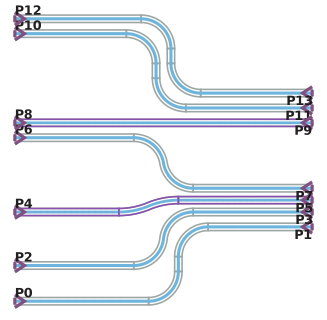
>>> ports1 = [... pf.Port((0, 0), 180, "Strip"),... pf.Port((0, 12), 180, "Strip"),... pf.Port((0, 30), 180, "Rib"),... pf.Port((0, 55), 180, "Strip"),... pf.Port((0, 60), 180, "Rib"),... pf.Port((0, 90), 180, "Strip"),... pf.Port((0, 95), 180, "Strip"),... ]>>> ports2 = [... pf.Port((100, 25), 0, "Strip"),... pf.Port((100, 30), 0, "Strip"),... pf.Port((100, 34), 0, "Rib"),... pf.Port((100, 38), 0, "Strip"),... pf.Port((100, 60), 0, "Rib"),... pf.Port((100, 65), 0, "Strip"),... pf.Port((100, 70), 0, "Strip"),... ]>>> component = pf.parametric.route_z(port1=ports1, port2=ports2, pitch=5, radius=10)