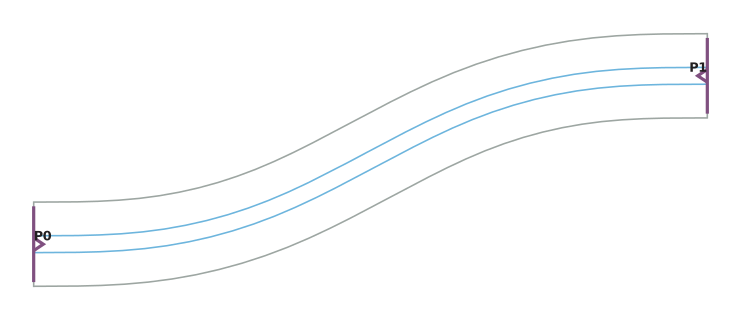

parametric.route_s_bend
route_s_bend( *, port1: photonforge.Port | tuple[photonforge.Reference, str] | tuple[photonforge.Reference, str, int] | None = None, port2: photonforge.Port | tuple[photonforge.Reference, str] | tuple[photonforge.Reference, str, int] | None = None, euler_fraction: Annotated[float, maximum=1, minimum=0] | None = None, technology: photonforge.Technology | None = None, name: str | None = None, model: photonforge.Model | None = None,) -> photonforge.ComponentCreate an S bend connecting 2 compatible ports.
Args
- port1: First port to be connected. The port can be specified as a
Portor as a tuple including aReference, the port name, and the repetition index (optional, only for array references). - port2: Second port to be connected.
- euler_fraction: Fraction of the bends that is created using an Euler spiral (see
Path.arc). IfNone, defaults to 0. - technology: Component technology. If
None, the default technology is used. - name: Component name.
- model: Model to be used with this component. If
NoneaWaveguideModelis used.
Returns
Component with the route, including ports and model.
Example
>>> component = pf.parametric.route_s_bend(... port1=pf.Port((0, 0), 180, "Strip"),... port2=pf.Port((20, 5), 0, "Strip"),... euler_fraction=0.5,... )